
Why Does My Skin Look Different in Every Mirror?


You leave the house feeling gorgeous. Then you flip down the car mirror and suddenly have questions, concerns, and a personal grievance with the sun.
Where did those lines come from? Were your pores always that noticeable? And why does your bathroom mirror seem to have a completely different opinion?
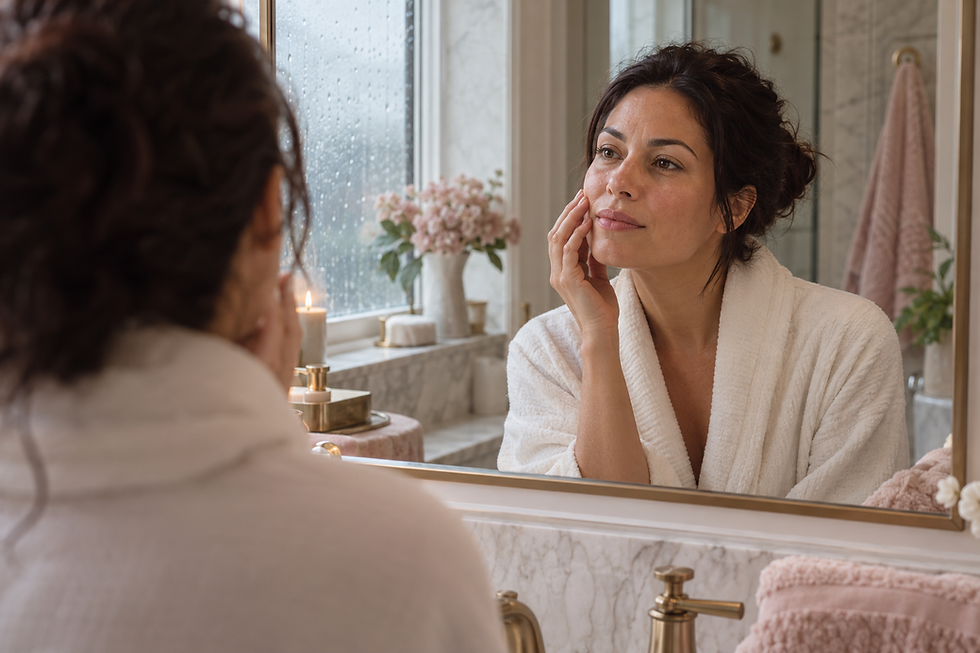
Before you rethink your entire skincare routine, here’s something reassuring: the way you see your skin depends partly on how you’re looking at it.
Same face. Different lighting.
Light changes where shadows fall across your face.
Soft, even light coming from in front of you can make texture appear less noticeable. Light coming from above or the side can create shadows that emphasize under-eye hollows, folds, and uneven texture.
That’s why your skin can look different in the bathroom, by a window, and under the overhead lights at work. Dermatology photography guidance recommends good, even lighting to help avoid misleading shadows.
The car mirror isn’t necessarily exposing some secret truth your bathroom concealed. You’re seeing your face under different conditions.
Your phone camera has an opinion, too.
Ever opened your front-facing camera and thought, That cannot possibly be me?
Camera distance affects facial proportions. Research has shown that photographs taken at close selfie distances can make features—particularly the nose—appear different from photographs taken farther away.
Add a different angle or expression, and you have another version of the same face. A close-up selfie is a photograph taken under specific conditions, not a final verdict on your appearance.
Magnifying mirrors make everything feel urgent.
A magnifying mirror can be helpful for a stray brow hair. It can also turn a normal skin check into a full investigation.
Pores, fine lines, and texture look more prominent when you enlarge them and inspect them from inches away. That view isn’t how people normally see you across a table.
Give yourself a little distance before deciding something needs attention.
So, how should you track your skin?
If you’re trying to assess your skincare or treatment progress, make the comparisons fair:
Use the same lighting and location. Avoid comparing a softly lit “before” with an “after” taken in harsh sunlight.
Keep your camera distance and angle consistent. Position the camera at the same height each time.
Relax your expression. A smile, squint, or raised brow can change the appearance of lines.
Skip filters and beauty modes. Keep makeup conditions consistent, too.
Record the date and treatment timing. An immediate after photo and a photo taken weeks later document different moments.
Consistent lighting and positioning are core recommendations for meaningful aesthetic before-and-after photography.
What this means at Doll Haus
This is why I care about tracking progress beyond a quick glance in the mirror. When we review your photos, the lighting, angle, expression, and timing all matter.
Tell me what you’ve been noticing and what you’d like to improve. That conversation helps us decide what deserves attention and whether a treatment fits your goals.
You don’t need to make a treatment decision because one mirror hurt your feelings.
Sometimes the most useful first step is a consistent photo—and a little less cross-examination under the bathroom lights.
Have a skin question? Bring it to your next Doll Haus appointment, or book a consultation at dhaesthetics.com. Let’s look at the bigger picture together.


Comments